
A Bi-Monthly Analysis of UHNW Asset Liquidity
Key Trends in UHNW Asset Liquidity
Standard market indicators (which typically measure sector specific transaction value, volume, and pricing) often fail to directly capture the unique and nuanced pressures affecting illiquid assets that high-net-worth individuals and families hold in their portfolios.
To address this gap and provide a clearer view of liquidity across unique assets, we developed the Leyster Liquidity Strength Index, a proprietary framework that incorporates factors such as shifting tastes, embedded leverage by asset type, and the market breadth of qualified buyers and sellers – each of these factors have significant, but varying, impacts on the overall liquidity scores we assign through our analysis.
The Leyster Liquidity Lens is our bi-monthly analysis powered by this index. It provides advisors and their clients with a consistent, data-driven view on the ease (or difficulty) with which private and alternative assets can be converted to cash. UHNW investors typically hold multiple illiquid positions, making it crucial to distinguish which can be mobilized quickly and which cannot.
Comments on changes from December 2025 to February 2026:
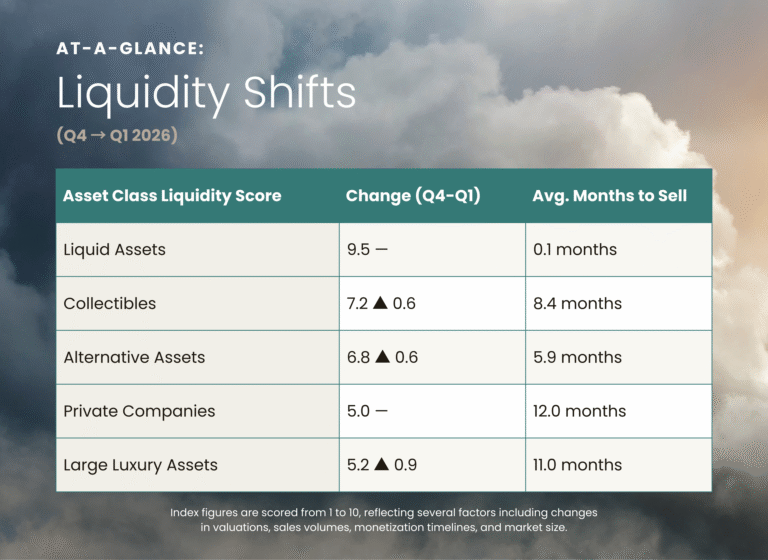
Collectibles & Large Luxury Assets:
The mood across the collectibles and large luxury asset market has grown exponentially more optimistic in just the last few months. Whether economically warranted or not, this pressure from luxury buyers is signaling that they are done playing wait and see.
- Collector Cars: January’s classic car auctions were the most visible exclamation point over the period. Across Barrett-Jackson’s Scottsdale and Mecum’s Kissimee auctions, a record US$ 678 million in collector cars changed hands, up 52% YOY. With average sale price up over 70%, and the number of lots sold down 14%, we are witnessing a booming market for blue chip autos.
- Luxury Homes: While there were meaningful transactions in 2025, the data was insufficient to signal a true recovery in the luxury housing market. That has now changed. US home sales above US$ 10 million increased 32% YOY to roughly 1,600 transactions. Whether driven by acceptance of new luxury taxes in select markets or a weaker dollar attracting foreign buyers, luxury homes are clearly far more liquid today than they were a year ago.
- This dynamic is echoed across fine art, watches, wine, yachts, and jets. While no marquee fine art auctions were held, strong results at newer Middle Eastern and Asian auctions suggest a rebound in international luxury purchasing.
Alternative Assets:
Dry powder continues to pile up across the segment. 2025 saw US$ 226 billion in secondary transactions (up over 40% YOY), all while a record US$ 215 billion remains dry. Commercial real estate is also beginning to stabilize. Office space, in particular, recorded positive net absorption in Q4 – the first such quarter since 2021.
Leyster Takeaway
While Q4 was marked by a surge in multibillion-dollar dealmaking, activity for the typical UHNW family remained more subdued. Now, midway through Q1 2026, that broader optimism appears to be spilling into luxury and alternative assets – at least for the moment.
DISCLOSURE:
METHODOLOGY
Leyster Capital’s Liquidity Strength Index is a proprietary framework designed to assess the relative ease with which ultra-high net worth (UHNW) assets can be converted to cash—without sacrificing control or value. Each asset category is assigned a score reflecting its liquidity profile based on real-time market behavior, financing accessibility, and buyer dynamics.
- Low Liquidity Scores indicate assets with constrained buyer pools, elongated sale timelines, and limited financing options. These are typically one-of-a-kind or highly specialized holdings, such as large superyachts or highly bespoke real estate.
- Moderate Liquidity Scores reflect stable-to-growing asset classes with active buyer markets, evolving valuations, and expanding capital solutions. Collector cars and high-value watches often fall within this range.
- High Liquidity Scores are reserved for asset classes that benefit from deep capital markets, short transaction cycles, and consistent financing access, such as publicly traded securities and select commodities.
Leyster’s metrics are derived from quarterly or semi-annual data across a curated basket of assets, each weighted proportionally to its market size within its segment. Categories include:
- Large Luxury Assets: Ultra-luxury homes, private aircraft, and large yachts.
- Alternative Assets: LP/GP interests in private equity and private credit funds, income-producing commercial real estate, and entertainment royalties.
- Collectibles: Blue-chip collector cars, fine art, rare timepieces, and investment-grade wine.
All liquidity assessments are based on publicly available data from trusted sources including S&P, Pitchbook, Bloomberg, Evercore, UBS Art Basel, Knight Frank, and Cushman & Wakefield.
The assessments are supplemented by publicly available data from reputable sources within niche asset classes including Hagerty, International Federation of the Phonographic Industry, BoatPro, Global Jet Capital, ArtPrice, and Liv-ex. Assessments are further validated by conversations with UHNW asset owners, relevant financing providers, and key advisors.
This methodology underpins Leyster’s ongoing commentary and charting of liquidity stress indicators across UHNW portfolios. It remains consistent across reporting periods and serves as a foundational benchmark in our analysis.